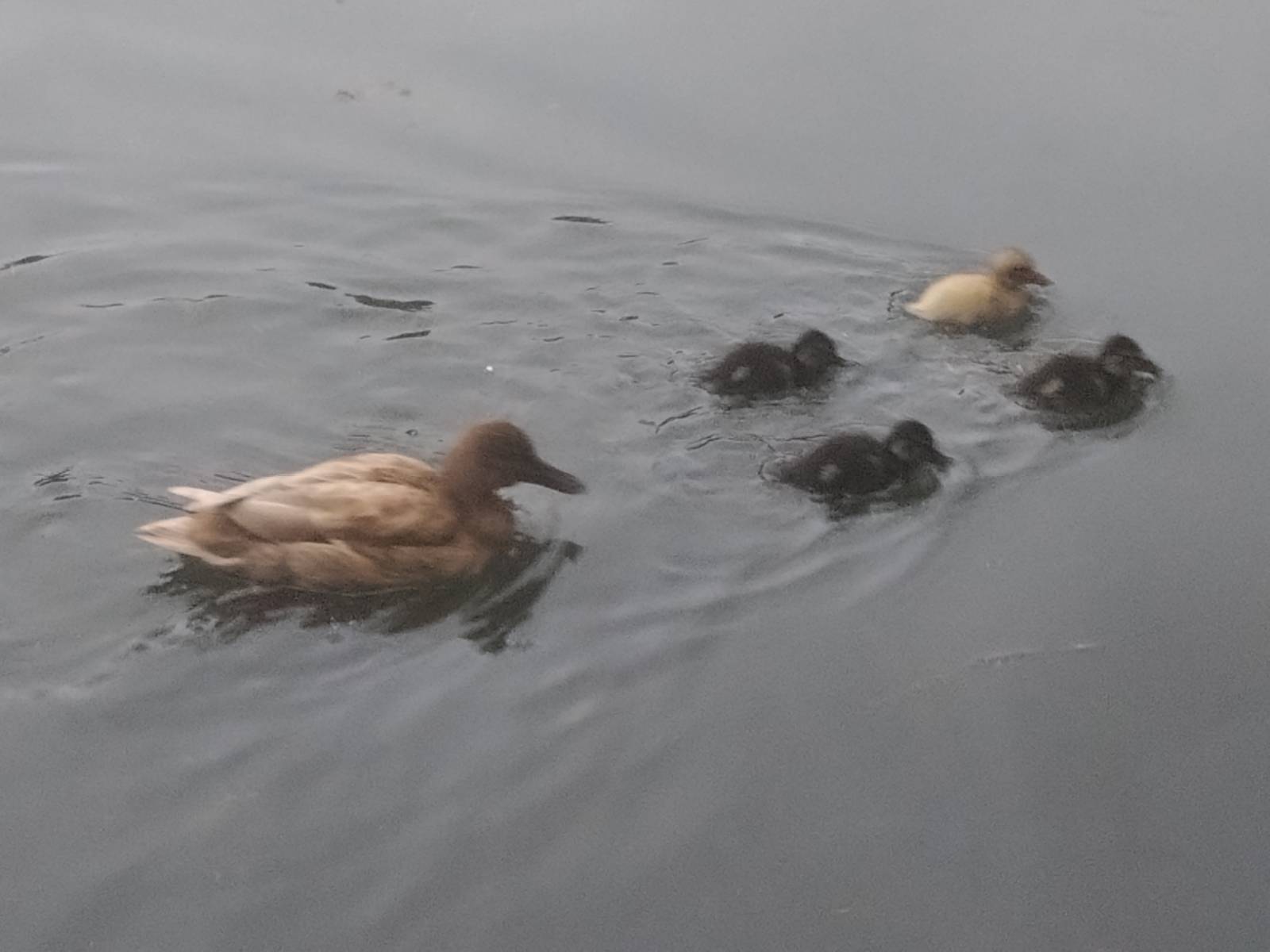
It began in the Islington tunnel. A head raised, barely a silhouette in the darkness. An anxious glance from between the plants on the roof.
And then, wings beating, she flew off into the darkness behind me, terrified. I panicked, not entirely sure what was going on, turning round to see where she had gone, crashing the boat into the tunnel wall, then regaining control and making it to the other end. There, I waited, alone but for a family half-heartedly fishing and whole-heartedly absorbing the day’s remaining warmth.
In the box garden on the roof of my boat lay 11 eggs, gentle blue amidst hues of twig and feather. Their temperature was dropping with the strange, hot April sun. Their mother, their only source of heat, was ever further away.
It seemed she wasn’t coming back. There was only one thing to be done.
——
Pets At Home is apparently a popular shop. A lack of alternatives, rather than genuine public enthusiasm, may be the reason for this. They do not sell incubators for bird, reptile or any other kind of egg. Nor do the local pet shop that advised me to phone Pets At Home.
Without access to an entry-level egg incubator at half-past-four on a Tuesday afternoon, what was I to do?
The eggs ended up on my sofa, on some fabric, on a slatted piece of wood with a hot water bottle wedged underneath. Some towels over the top tried to keep the heat in, though neither the towels nor I knew exactly how much heat was going in, nor how much of it should be kept.
This was a guessing game, not a realistic long-term plan.
The next day the world wide web, that infinite fount of knowledge and inanity, told me how to build an incubator. There were three things I didn’t have: a thermometer, a hygrometer (which measures humidity), and an incandescent lightbulb attached to a cable with a dimmer switch, ending in a plug.
A thermometer-hygrometer is surprisingly easy to get hold of. A lightbulb on a cable with a dimmer switch is not.
It was right there and freely available online, but that was the problem: online is there, not here. What was here was a retail park on the fringes of Southall, and I was in it.
Ten minutes away, on Coldharbour Lane in Hayes, Zahir was sitting in his electrical shop. I began cycling in his direction.
——
Hayes Electrical Wholesalers is flanked by an Afghan bakery and a Punjabi pub. For good measure, there’s a fish-and-chip shop next door but one. I have no idea where Zahir eats, but I do know that he knows how to connect a plug, to a cable with a dimmer switch, to an incandescent lightbulb.
He seems to have been sitting in this shop for a long time, slowly becoming one with the counter and his towering piles of stock, a pillar of the community becoming ever more pillar-like in form. My predicament animates this friendly human monolith.
On shelves and in cupboards Zahir fishes around for an incandescent lightbulb, mumbly intimating that it might somehow be bad form, or even against the law, to still have any knocking around. But the law is no impediment to kindness. “I knew I had one!” came a muffled cry from a dusty recess, and he set to work.
“Normally I charge seventy-five pounds for this,” he told me about fifteen minutes later, leaving me wondering once again why I had never trained as an electrician. “But I always wanted to do this with my children, to raise some duck eggs, so you can pay me what you like.”
That turned out to be a lot less than seventy-five pounds, though not for lack of gratitude. There are also some things money probably can’t buy. I told Zahir that if any ducklings were to hatch, the first would be named after him.
——
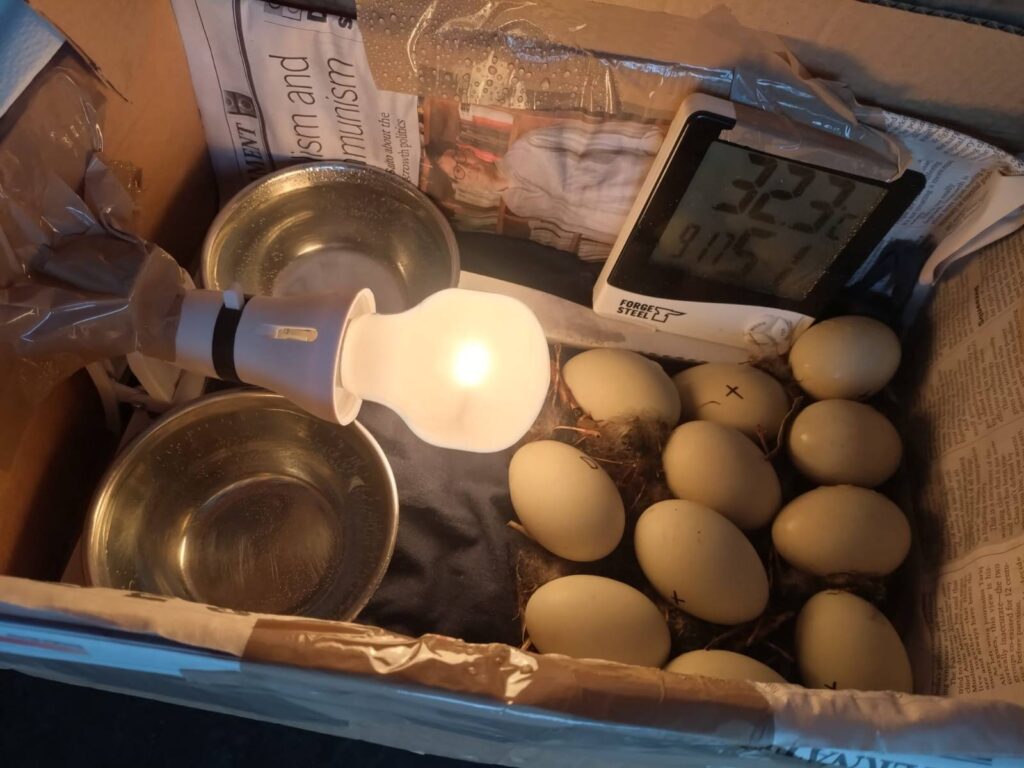
An hour later, the eggs had a new home. Now they lay amongst fragments of their former nest, on newspaper, in a shoebox with an incandescent lightbulb poking in, flanked by two small bowls of water. The aim: a temperature of thirty-seven point five degrees centigrade and humidity of sixty per cent.
But this was still not a realistic long-term plan. Could I bring up a duck, possibly ducks? The possibility appealed to me. For quite some years now, I’ve liked the idea of having a pet duck.
Then I looked at my calendar for the coming months. How many summer weekends in a field can a tiny, fragile duckling handle? And if I were their parent, would I need to be with them non-stop, to save them from abandonment-related distress and possible death at the hands of either unscrupulous predators or simple accident?
I had reason to suspect that looking after tiny beings is an attention-heavy job, and that my attention may not have been heavy enough.
——
A nesting mother duck leaves her eggs just a few times a day, for about 20 minutes a time. Then she snuggles back on top, rotating the eggs along their long sides, distributing body heat by shifting those at the edge of the clutch to the inside, over and over again, desperately hoping a fresh round of floating fluffballs will emerge to carry her genetic material into the future.
It takes around four weeks for a duckling to emerge from an egg. In there, a duck embryo has everything it needs except for heat and oxygen. These seep in through infinitesimally small portals in the shell: heat from the mother, oxygen from the air. Carbon dioxide and water vapour go in the opposite direction. Cells divide, organs form, skin grows, a heart beats, muscles twitch. Is life, as Betül Kaçar has said, ultimately just chemistry that has developed a long-term memory?
None of this was on my mind at the time. Instead, I was wondering if I could have a say in naming any ducklings that I handed over to better-qualified caregivers. I knew that any ducklings were going to have to go. Apart from anything else, it seemed unfair on a duck for it to be raised by a human, when there were so many potential adoptive duck families out there.
From previous run-ins with wildlife rescue organisations I knew that they were crewed by relentlessly dedicated, though perhaps slightly odd, people. I began phoning them.
Two gave immediate refusals and suggestions of where else to phone. The third pointed out that, by law, I shouldn’t’ve put the eggs in an incubator in the first place, they should have been left in the nest, “but they were on your boat, you can’t do anything else.”
She was completely wrong. I could have left them where I found them, but that seemed grossly unfair, given the circumstances. I had guilt that needed assuaging.
The clue, anyhow, is in the name: wildlife rescue organisations are organisations for rescuing wild life. An egg-bound embryo, an eggling, does not really fit this description. A new home would have to be found after the life became wild.
So the eggs stayed with me, and my suspicions were correct. Caring for tiny beings, encased in eggs or not, is an attention-heavy job.
——
I began waking up two or three times a night to check the temperature, convinced that a premature end would come in the form of not enough, or too much, heat. Concerned about low humidity, I added a layer of bubble wrap over the newspaper insulation, and was greatly relieved when it worked. I drew X’s on one side of the eggs and O’s on the other, so it was clear which way they needed to be turned.
With no thermostat to automatically control the temperature, the idea of leaving the eggs alone for any sustained period of time was troubling. Then I had to go away for two nights.
Before leaving, I candled the eleven eggs. By holding a torch underneath an egg, you can get some idea of what is going on inside. By this stage there should at least have been veins visible on the insides of the shells. In two of them, the torchlight produced nothing but a strange translucent peachy glow. I laid them in a hedge at the edge of the boatyard, where a new role in the great circle of life no doubt awaited them.
The nine remaining eggs came with me into central London, and then went with a friend on the bus to Wood Green. There they would be cared for temporarily by more friends. Trying to explain over the phone to an exacting eight-year-old which way to rotate duck eggs is a challenging task.
A week later, on a Saturday afternoon, the setting sun was letting the spring chill back into the air. The eggs had been looked after royally in Wood Green, and from there they were coming back to Clapton, to a picnic in the park. By the time night fell, I knew carrying them back to Watford was going to be beyond me.
Luckily, there is an innate human desire to look after something that may produce an impossibly cute, cheeping ball of fluff, and a new home was found on a nearby boat. Before the eggs went, it was time for another candling. Three more were laid in the grass under a tree in the orchard; six were carried onwards.
——
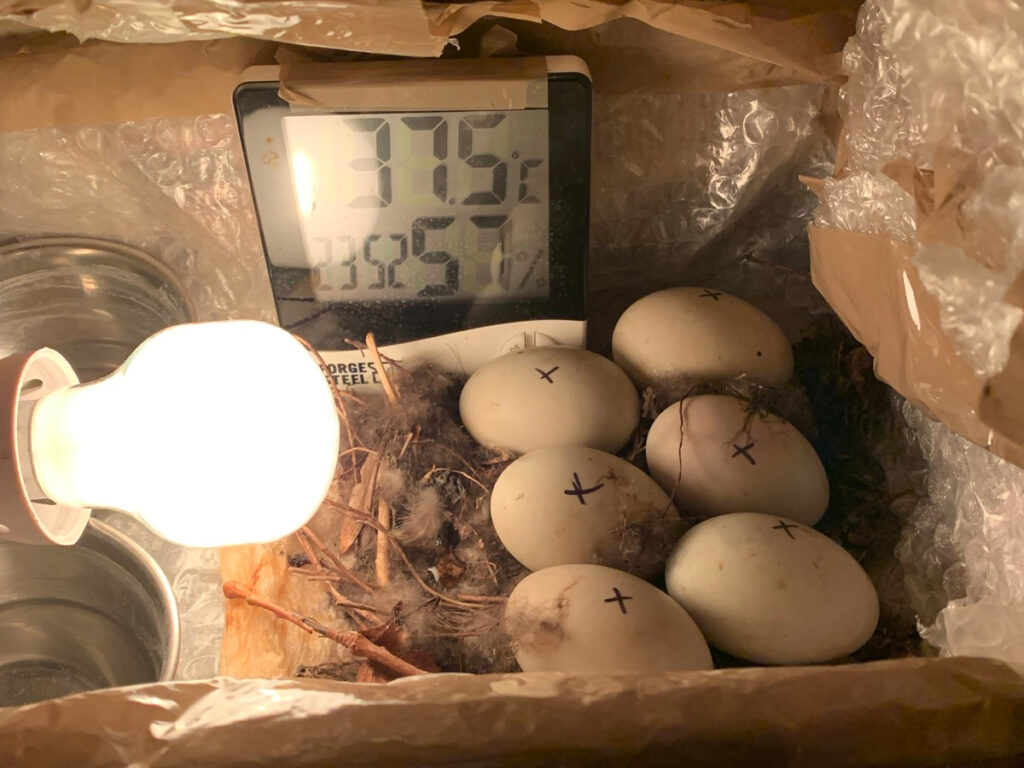
A week later, it had become clear that only one of the eggs held a potential duckling, and that one potential duckling wanted to live. It began the process of birthing itself by piercing the air sac inside the egg receiving its first gasps of oxygen.
After this the creature rests, adjusting to this new really. It can take anywhere between 24 and 48 hours for a duckling to take the next step: breaking the egg’s shell and emerging into the world. It does this using something called an egg tooth. This is a tooth on the end of a duckling’s beak that exists only to break the eggshell. When that is done, it falls off. Evolution is remarkable.
But for reasons unknown, the duckling couldn’t make it out of its brittle blue cocoon by itself. By the time human help arrived, it was already too late.
The eggs had come full circle: from Clapton, to Watford, to Wood Green, and now back to where they began. I wondered where their mother was. At the mouth of the Islington tunnel, hoping for her nest to re-emerge on the strange puttering metal beast that had carried it off? Eating crusts of sourdough bread by the lock? Sitting on another clutch of eggs? Planning revenge on the tall, pink, long-limbed beast that piloted the puttering metal beast?
We will never know, and there will be no ducklings asking themselves the same question.